
Subdued demand from developed countries and blocs like the US and EU is impacting exports of key sectors including engineering, gems and jewellery and may have implications on India's exports in case the global situation does not improve in coming months. Global inflation, Russia-Ukraine war, simmering China-Taiwan crisis and supply disruptions are hurting economic growth worldwide, leading to poor demand, experts say. The world merchandise trade volume is expected to grow 3 per cent in 2022 against the earlier forecast of 4.7 per cent, mainly due to the ongoing war between Russia and Ukraine, according to the World Trade Organization forecast, released in April.

'The finance minister has done as much as she can when you look into the fiscal constraints she had.'

According to ICRA, even in a high-growth scenario, wherein the second half of FY20 sees the incremental bank credit rise to Rs 6.5-7 trn, there will still be a 40-45% year-on-year decline.

For India to transform into a high-income country with a projected gross domestic product (GDP) of $23-35 trillion, will need a sustained annual growth of 8 per cent to 10 per cent. This will be powered by India's demographic dividend, technological innovation, and sectoral transformation, according to the "India@2047: Transforming India Into A Tech-Driven Economy" report by Bain & Company and Nasscom. By 2047, the services sector is expected to contribute 60 per cent of India's GDP, while manufacturing will account for 32 per cent, both playing a pivotal role in economic expansion.

Despite gross domestic product (GDP) growth being lower-than-expected for the July-September quarter, the six-member Monetary Policy Committee (MPC) may not cut the policy repo rate in the review meeting scheduled for next week due to high inflation in October, according to experts. "Consumer Price Index (CPI) inflation breaching the upper limit of the RBI's tolerance band in October (6.2 per cent year-on-year) is not a favourable backdrop for the MPC to commence the easing cycle, even as the growth outcome disappointed the MPC's expectations," said Shreya Sodhani, regional economist at Barclays, who expects the policy repo rate to be kept unchanged in the December meeting.
Indian along with Indonesia showed strong growth despite a global economic slowdown in the final quarter of 2011, according to the International Monetary Fund (IMF).

Delhivery share price dropped 6.6 per cent to a low of ?295.8 per share on the BSE on Monday after analysts cut their earnings estimate on the stock, following weak results for the December quarter (Q3) of the current financial year (FY25). Q3 is a seasonally strong quarter due to festive pick-up in demand.

There has been a sharp recovery in the headline corporate earnings in the April-June 2023 quarter (Q1FY24), after a dismal showing by early bird companies. The combined net profit of the 983 listed companies that have declared their quarterly results, so far, was up 64.7 per cent year-on-year to record a high of Rs 2.68 trillion in the first quarter, but growth in earnings remained lopsided because most of the incremental gains came from a handful of companies. Moreover, the quarterly numbers showed a continued slowdown in revenue growth.

The hospitality industry has seen plenty of interest since the catastrophic impact of the pandemic, which led to losses in FY21. The hotel industry market cap has more than tripled since 2019 on the combination of a strong earnings rebound and positive surprises, as well as three recent listings. The industry has good tailwinds. The anticipation is, demand for rooms will outrun supply for a few years despite capacity expansions.

'Expect India to keep doing well irrespective of geopolitics.'

'The central bank has highlighted that the slowdown in growth has been limited to a few sectors and overall growth is expected to pick up in the second half of the year.'

Growth has slowed in some of the large emerging economies, its interim economic assessment report added. "One factor has been a rise in global bond yields -- triggered in part by an expected scaling back of the US Federal Reserve's quantitative easing -- which has fuelled market instability and capital outflows in a number of major emerging economies, such as India and Indonesia.

There has been a sharp slowdown in revenue and profit growth in the cement sector in recent quarters but it is yet to show in the share prices of cement companies. On the contrary, there has been a rally in cement stocks and a re-rating of their equity valuation in the past three years despite an earnings contraction during the period.

Inflows into equity mutual fund (MF) schemes declined for the third month in a row in March even though the equity market recovered sharply. Equity MF schemes raked in a net Rs 25,082 crore in March, down 14 per cent from February.

If growth reverts to the pre-Covid level, a lot of people may have to temper their rosy optimism, points out Debashis Basu.

Leading passenger vehicle maker Maruti Suzuki on Saturday reported marginal growth while Hyundai and Tata Motors posted a decline in their sales in February as a slowdown in the market continued with demand remaining muted. On the other hand, Mahindra & Mahindra and Toyota Kirloskar Motor posted double-digit growth riding on their SUV and MPV models.

China on Friday said it is assessing whether to start trade talks with the US on tariff reductions following recent approaches by Washington, a move that would possibly ease the tit-for-tit tariff war between the world's two largest economies. "China is making assessments as the United States has recently reached out to convey messages to China through relevant parties many times, expressing hope to engage in talks with Beijing over tariff issues," the Chinese Commerce Ministry said in a statement in Beijing.

The ideal time to invest in sector funds, is during a downturn so that investors can capitalise on a turnaround in 1.5 to 2 years.

In an eventful week ahead, stock markets may face volatile trends before the RBI's interest rate decision and the US inflation data announcements, as investors continue to assess the broader implications of US tariffs on global economy and inflation, analysts said. Investors fear that a full-blown trade war will impact global trade and economic growth, according to market experts.

Bharat Electronics (BEL) reported excellent results for the January-March quarter (Q4) of FY24, which were driven by decent EBITDA margins and higher PAT as well as good revenue growth. Order inflows were also good. BEL is a major beneficiary of the policy of defence indigenisation.

IMF has praised India's economic performance and has negated the concept of decoupling as economies today are much closely related to each other.

Indian IT services sector's revenue growth will slow down to 3 per cent in the current fiscal from 9.2 per cent in the previous financial year, a domestic ratings company said on Tuesday. Icra Ratings said the profitability will also take a beating in this financial year and the operating profit margin will narrow by up to 1 percentage point to 20-21 per cent. The topline growth will come down to 3-5 per cent in FY24 from the 9.2 per cent posted in FY23, the agency said, attributing the slowdown to softening demand.

ICICI Prudential Life Insurance (IPRU) disappointed the market even though some analysts said the Q3FY25 results were in line. Most analysts cut margin estimates. The insurer reported M9FY25 growth of 8.5 per cent year-on-year (Y-o-Y) in value of new business (VNB) premium to Rs 1,575 crore, while total annual premium equivalent (APE) grew 27.2 per cent to Rs 6,910 crore.

Private life insurers experienced reasonable growth in the July-September quarter (second quarter, or Q2) of 2023-24 (FY24), and the October data is also encouraging. The individual weighted received premium (WRP) for private players grew by 19.8 per cent year-on-year (Y-o-Y) in October. However, Life Insurance Corporation (LIC) of India had slower growth, pulling the industry growth rate down to 13 per cent Y-o-Y.

The stock of mall developer and commercial real estate major, The Phoenix Mills (Phoenix), is up 26 per cent since its business update in the third week of January. The gains came on strong December quarter performance and the consumption boost in the Budget which is expected to help the company sustain its growth trends.

'If you look at the order books of capital equipment companies or money deployed on the ground, there is forward movement in terms of actual investment by the private sector.'

Since October, FPIs have offloaded Indian equities worth Rs 2.1 trillion.

All Sensex shares, except for Hindustan Unilever, ended with losses. Tata Steel fell the most by 7.33 per cent followed by Larsen & Toubro which cracked 5.78 per cent. Tata Motors, Kotak Mahindra Bank, Mahindra & Mahindra, Infosys, Axis Bank, ICICI Bank, HCL Technologies and HDFC Bank were the other big laggards. Hindustan Unilever ended marginally higher.

The International Monetary Fund (IMF) on Tuesday said it is expecting some slowdown in the Indian economy next fiscal year and projected the growth to 6.1 per cent from 6.8 per cent during the current fiscal ending March 31. The IMF on Tuesday released the January update of its World Economic Outlook, according to which the global growth is projected to fall from an estimated 3.4 per cent in 2022 to 2.9 per cent in 2023, then rise to 3.1 per cent in 2024. "Our growth projections actually for India are unchanged from our October Outlook.

After bumbling for years since 2014, the Modi government seems to believe that massive government expenditure will lead us to prosperity supported by 'seat-of-the-pants' decision-making, observes Debashis Basu.

'I am optimistic about the Budget because of the fiscal discipline the government has committed to.'

If the fiscal deficit target of 4.9% of GDP has to be met for 2024-2025, which the government must in view of the uncertainties and challenges emerging both domestically and globally, the finance ministry may see in the composition of the current year's capex a sliver of hope, notes A K Bhattacharya.


'Future market gains will likely depend primarily on earnings growth.'

'Even if India is attractive, FPIs currently lack the funds to invest, as money is being redirected to the US.'

Avenue Supermarts, the operator of DMart retail chain, reported good results for the July-September quarter (Q2FY24) with strong earnings before interest before interest, taxes and depreciation (Ebitda) and profit before tax (PBT) growth, but lower PAT due to higher tax incidence. The operating margin improved, and like-to-like store sales growth was strong. Average bill value also increased though this may be a seasonal effect to some extent. Analysts are assuming this means the slowdown in retail may have bottomed out.
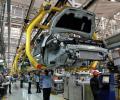
Auto parts exports from India may see a slight slowdown as US President Donald Trump's 25 per cent tariff could increase car prices for buyers by 8-25 per cent, thereby affecting demand, experts believe.

The finance minister, in her Budget speech, should focus more on what she is directly responsible for, rather than on programmes where her role is largely supportive, notes Nitin Desai.

Defying the bearish sentiment in the markets on Monday, ICICI Bank's share price rose by 2 per cent, reaching an intraday high of Rs 1,234.4 per share on the BSE. With a 1.5 per cent gain at the close, the stock emerged as the top performer on both the BSE Sensex and the National Stock Exchange Nifty 50 indices.

Gold is an excellent asset class for diversification and should be included in all long-term portfolios.
